For World Peace
The Great Salt Lake Act
The Creation of The Great Salt Lake Act establishes a Quantum Congress and the role of Planetary Information Security Officer with the purpose of immediately restoring The Great Salt Lake and establishing protection from Planetary Threats putting at risk our shared existence, and to bring an age of World Peace.
I present to you a dashboard of Planetary Health Benchmarking for The Great Salt Lake and explaining with quantifiable physics why our body of water is evaporating and how we can use physics to restore The Great Salt Lake back to full health. Due to the expansiveness of the cyberthreat facing our planet and the various entities an Act of Congress is required.
Great Salt Lake Restoration
Lakebed Restored
The Great Salt Lake has lost over 60% of its water volume since 1847. The exposed lakebed, approximately 1,208,000 acres, is a source of toxic dust containing arsenic, mercury, and lead. Windstorms carry these particulates across the Wasatch Front, affecting 2.5 million residents. Restoration is measured by acres of lakebed returned to water coverage.
608,128
of 1,208,000 acres restored
50.3% of historic basin sliders
1,208,000 acres (1,888 mi²) of toxic lakebed exposed. Current: 608,128 acres of lake (950 mi², 4,191 ft). Full recovery requires ~4,203 ft (+12 ft rise). The 800K AF/yr Strike Team goal recovers ~33% at equilibrium.
Elevation
4,191 ft
Target: 4,198–4,205 ft
Surface Area
950 mi²
Target: 1,700 mi²
Volume
15.0 km³
Target: 18.92 km³
Salinity
~16 %
Target: 13–15%
Annual Natural Loss
−2.0 km³/yr
70.5 tonnes/second. already shrinking
Evaporation
113,400 kg/s
2.9 M AF/yr. dominant loss
Precipitation
15,600 kg/s
0.4 M AF/yr
Our existence adheres to and is governed by the laws of physics. Every system which exists must abide by and be aligned to the eternity's we exist within. The Salt Lake Valley hosts a special body of water which provides the food supply chain for the entire planet. When the planet is within thermodynamic equilibrium and planetary resources not being exploited, hoarded, or infected, the Great Salt Lake is full, prosperous, and gentle powdery snow caps our mountainous region upon which you can float and feel your spirit uplift. Too much heat, strain, and squandering, however, results in a simultaneous collapse which causes a chain reaction across the Earth.
Restoration Deficit
−3.92 km³
Gap to healthy lake
Migratory Birds
10M+ annual
338 species, Pacific Flyway
Brine Shrimp
At Risk
World food supply. Collapse at 20% sal.
Brine Flies
At Risk 2022–
Primary shorebird food source
Island Nesting
Land Bridge formed
Predator access to colonies
Recovery Inflow Needed
800K AF/yr
Minimum viable, sustained 30 yrs to 4,198 ft
Snowpack (SWE)
Declining trend
Dust on snow accelerates melt
Equilibrium Warming
+0.25 °C
ΔT from fleet waste heat
Lake Temp 2025
12.9 °C
286 K mean annual surface
Lake Temp 2065 (Fleet)
13.7 °C
+0.77 °C above baseline
Lake-Effect Snow
Altered
Warmer, smaller lake changes snowfall
Evaporation Season
+2–3 weeks
Extended by warming. Water gone forever.
Humanity now faces two paths. There is no time left to kick the can down the line to another generation. We have known for decades this moment would come and now the moment is here on your ballot. We are the civilization who must answer the call and restore the Great Salt Lake for the whole world. Our decision this election ripples around the globe.
The Great Salt Lake supports 10 million migratory birds, 338 species, and a $1.5 billion/year brine shrimp industry. The ecosystem has tipping points: salinity thresholds beyond which populations collapse.
Migratory Birds
10+ million
338 species. Western Hemisphere flyway.
Brine Shrimp Industry
$1.5 B/year
World Food Supply, Aquaculture feed, global export
Wilson's Phalarope
50% of world pop.
Stages at Great Salt Lake
Eared Grebe
80% of N. American pop.
Stages at Great Salt Lake
Brine Flies
Near Collapse 2022
Primary food source for millions of shorebirds. Nearly wiped out when salinity hit 19%.
The Great Salt Lake upholds the world in two crucial ways, operating as both a cooling body and the beginning of the global food supply chain through the brine shrimp population. The brine shrimp supply 45% of the world's aquaculture feed, upholding the global food supply chain and feeding the Pacific Flyway, where 10 to 12 million migratory birds from 350 species refuel at the Great Salt Lake on journeys spanning from Arctic Russia and Alaska to Tierra del Fuego. Without the lake, they lose their last major stopover. There is no backup lake, as the Aral Sea's supply is already gone and Lake Urmia's is already gone. The birds control the pests which allow for healthy and plentiful crops. With them gone, the natural food order will break.
Restore the Flow
Bear River
0 AF/yr
Diverted: ~550,000 AF/yr of 1.75M natural flow. 93% to agriculture. Most goes to invasive Alfalfa.
Weber River
0 AF/yr
Diverted: ~200,000 AF/yr of 0.5M natural flow. 62% agriculture, 38% municipal. 15% of lake inflow.
Jordan River
0 AF/yr
Diverted: ~350,000 AF/yr of 0.7M natural flow. 55% agriculture, 45% municipal/industrial. 22% of lake inflow.
Mineral Extraction
0 AF/yr
Up to 270,000 AF/yr evaporated in solar ponds. Compass Minerals returning 200,000 AF/yr under 2025 agreement.
608,128
of 1,208,000 acres restored
50.3% of historic basin
Total Returned
0 AF/yr
0% of Strike Team goal
Volume Recovered
0 km³
Deficit: 3.92 km³ to healthy
Lake Volume Recovery Timeline
Green: volume trajectory with water returned. Dashed: baseline (no additional water). Red dashed: healthy target (18.92 km³ at 4,200 ft). The deficit is currently 3.92 km³. Each AF returned = 1,233.5 m³. Sources: Null & Wurtsbaugh 2020, Wurtsbaugh et al. 2017, Great Salt Lake Strike Team 2022–2026.
Restoration Timeline
Move the sliders to return water to the lake. The Strike Team needs 800,000 AF/yr. that's 62% of what agriculture alone diverts from these three rivers.
Sources: Null, S.E. & Wurtsbaugh, W.A. (2020) "Water Development, Consumptive Water Uses, and Great Salt Lake," Springer. Wurtsbaugh et al. (2017) "Decline of the World's Saline Lakes," Nature Geoscience 10:816. Wine et al. (2019) "Climatization: Negligent Attribution of Great Salt Lake Desiccation," Climate 7(5):67. Bear River Compact, AquaPedia. Great Salt Lake Strike Team Reports 2022–2026.
The second way the Great Salt Lake secures the world is that the lake operates as a heat sink. Its collapse will chain reaction into the Colorado River system, which supplies water to 40 million people across seven states and northern Mexico. After Mexico, the heat reaches Alaska, Russia, the entire United States, and South America. The next wave reaching Europe and spreading across the continents all the way into China and Japan. The Great Salt Lake thriving is the thriving for the entire world.
The Hidden Groundwater Ledger
Groundwater contributes ~313,500 AF/yr to the Great Salt Lake. Every well drilled into the basin intercepts water that would otherwise seep into the lake. This contribution was estimated at only 75,000 AF/yr until a 2024 study (Zamora & Inkenbrandt) revealed the true number is 4× higher. The hydrology is "poorly understood" (Utah State Engineer, 2025).
Slide right to protect groundwater from pumping.
GW Protected: Data Centers
0 AF/yr protected
Planned pumping: up to 20,000 AF/yr. Joule Capital: 10,000 AF/yr rights secured. Creekstone/others: est. 5,000–10,000 AF/yr. Slide right to stop pumping, each AF protected reaches the lake. Salt Lake Tribune, Jan 2026.
GW Protected: Other New Wells
0 AF/yr protected
Planned/approved pumping: up to 50,000 AF/yr. Subdivisions, ranching, lithium mining, new ag wells. ~2,500 AF approved 2022–2024 during "closure" via exceptions. Slide right to protect aquifer. SL Tribune, Feb 2025.
GW Lost to Pumping
0 AF/yr
Intercepted before reaching lake
Net GW Reaching Lake
313,500 AF/yr
100% of natural groundwater inflow
Section I
Invasive Water Usage
Every acre-foot of water diverted from the Great Salt Lake basin, whether by irrigation canals, cooling towers, municipal taps, or groundwater wells, is an acre-foot that never reaches the inland sea. In an endorheic system there is no downstream to pass the cost to; the inland sea absorbs every loss directly. As inflows decline, salinity rises beyond what brine shrimp can tolerate, the surface shrinks, and hundreds of square miles of toxic lakebed are exposed to wind.
Use the sliders below to return water from each source and watch how quickly the inland sea recovers.
Alfalfa
0
AF/yr consumed
Non-native crop from Iran consuming 68% of Utah's water for 0.2% of GDP. 3.468M AF/yr. 29% exported to China. Replace with Native Indian-Rice Grass.
0% converted
Phragmites
0
AF/yr recovered
Invasive reeds consuming water via evapotranspiration before it reaches the inland sea. Current loss: 30,000 AF/yr.
0% removed
Nuclear Fleet
0
AF/yr new loss
Proposed 4 GW Holtec SMR-300 fleet. 8.97 GW waste heat drives additional evaporation via Clausius-Clapeyron. Max impact: 46,130 AF/yr.
0% of fleet built
Data Centers
0
AF/yr new loss
Direct cooling water + waste heat increasing basin evaporation. Growing rapidly with AI expansion. Max projected: 15,000 AF/yr.
0% of expansion built
Water Returned
0
AF/yr recovered
New Threats
0
AF/yr new losses
Net Change
0
AF/yr vs. today
Baseline: current conditions at 608,128 acres.
Lake Surface Area
608,128
acres at equilibrium
Section II
Heat
Heat is the invisible killer. Every watt of waste heat rejected into the Great Salt Lake basin raises the water temperature, which increases evaporation exponentially via the Clausius-Clapeyron relation. 6.5% more evaporation per degree kelvin. In an endorheic system, this heat has nowhere to go. It accumulates until the inland sea reaches a new, smaller equilibrium and becomes smaller, condensing the salinity and making it harder for the brine shrimp, and food chain to thrive.
It has been proposed to meet a scaling demand that we bring in nuclear power to accommodate for data centers. With a Quantum Congress and the establishment of a Planetary Audit with a Planetary Budget the question comes into play if Earth has the materials needed to keep scaling or if the way to go is towards next generation precision technology.
Adjust the sliders below to model the thermal load from each source.
Nuclear Fleet
0.00
GW waste heat
Proposed 4 GW Holtec SMR-300 fleet rejects ~8.97 GW as waste heat. Efficiency ~31%. for every 1 GW of electricity, 2.24 GW enters the basin.
0% of fleet operational
Data Centers
0.00
GW waste heat
Utah's growing data center corridor. Each 100 MW facility rejects ~85 MW as heat. Projected buildout: up to 2 GW of IT load.
0% of projected buildout
ASIC Mining Devices
0.00
GW waste heat
Proof-of-work mining rigs convert 100% of electricity to heat. These are cyber threats to critical infrastructure and ICE needs to cool them down. Projected basin load: up to 1.5 GW.
0% of projected buildout
Oil Refineries
0.85
GW waste heat
Five refineries along the Wasatch Front (Chevron, Marathon, Big West, Silver Eagle, HollyFrontier). Currently operational, existing thermal load.
100% operational
Vehicles & Transport
1.20
GW waste heat
~1.5M registered vehicles in the basin. Internal combustion engines reject ~70% of fuel energy as heat into the local atmosphere. Great Salt Lake Act requires corporations to move to the areas of the people they employ.
100% current fleet
Industrial & Commercial
0.60
GW waste heat
Manufacturing, mining, smelting, and commercial HVAC along the Wasatch corridor. Includes Kennecott copper, steel mills, and cement plants.
100% current output
Urban Heat Island
0.35
GW excess heat
Salt Lake metro area: asphalt, concrete, and buildings absorb and re-radiate solar energy, raising local temperatures 2–5°F above surrounding areas.
100% current extent
Total Waste Heat
3.00
GW into basin
Additional Evaporation
0
AF/yr from heat
Basin Temperature Rise
+0.000
°C at equilibrium
Operation Gigawatt is being planned for Brigham City, directly on top of the Great Salt Lake, next to the Bear River Migratory Bird Refuge. Every reactor converts uranium into heat. Approximately 30% becomes electricity. The remaining 70%, the waste heat, must be rejected to the environment. In a terminal basin with no outlet, that heat has nowhere to go except into the water and the air.
9.0 GW Continuous Thermal Load
The proposed fleet would inject 8.97 gigawatts of waste heat into the Great Salt Lake basin continuously for 24,100+ years. The Great Salt Lake is a terminal basin with no outlet. Every joule of heat added either raises the water temperature or evaporates water. The water that evaporates is gone permanently.
U.S. Nuclear Regulatory Commission, "Backgrounder on Radioactive Waste." Fission products including Cesium-137 and Strontium-90 account for most of the heat in high-level waste for up to 1,000 years. NRC.gov.
U.S. Nuclear Regulatory Commission, "Backgrounder on Radioactive Waste." Fission products including Cesium-137 and Strontium-90 account for most of the heat in high-level waste for up to 1,000 years. NRC.gov.
Waste Heat per Reactor
750 MW
1,050 MW thermal − 300 MW electrical
Fleet Waste Heat
8.97 GW
13 × 750 MW × 92% CF
40-Year Energy Injection
1.13 × 10¹⁹ J
Cumulative joules into basin
Equivalent To
2.4 million
homes running electric furnaces 24/7 for 40 years
Once Built, A Reactor Never Truly Stops
A nuclear reactor is not like a furnace you can switch off. When a reactor shuts down, whether for maintenance, refueling, or an emergency, the uranium fuel inside continues producing heat from radioactive decay. This decay heat cannot be turned off, controlled, or wished away. It is a fundamental consequence of nuclear fission: the atoms that were split leave behind unstable fragments that keep releasing energy for days, weeks, and years. A reactor that has operated for any length of time must be continuously cooled even after shutdown, or the fuel will overheat. This is what failed at Fukushima, not the reactor itself, but the cooling systems that . Every reactor in the proposed fleet will produce decay heat from the moment it first operates until long after it permanently closes. If built, the Great Salt Lake basin must continue to provide water to the fission reactor(s) for at least 1,000 years otherwise risk a Fukushima level event on a fault line.
The International Atomic Energy Agency's official report "The Fukushima Daiichi Accident," 2015. Confirms the accident was caused by loss of cooling water to manage decay heat after shutdown, not by the earthquake directly.
Slickrock: Utah State University Geoscientists Explore Why Utah's Wasatch Fault Is Vulnerable to Earthquakes, Geological Society of America journal Geology, April 2025.
The International Atomic Energy Agency's official report "The Fukushima Daiichi Accident," 2015. Confirms the accident was caused by loss of cooling water to manage decay heat after shutdown, not by the earthquake directly.
Slickrock: Utah State University Geoscientists Explore Why Utah's Wasatch Fault Is Vulnerable to Earthquakes, Geological Society of America journal Geology, April 2025.
Decay Heat After Shutdown: It Doesn't Stop
Decay heat never reaches zero. After shutdown, fission products continue releasing heat: P(t) = P₀ × 0.066 × t⁻⁰·². At 1 hour: 173 MW. At 1 day: 118 MW. At 1 week: 91 MW. At 100 years: 11 MW. At 300 years: 9 MW. At 1,000 years: 7 MW. At 24,110 years: 4 MW.
Water commitment: Decay heat must be removed by water. At 1 year post-shutdown the fleet requires cooling equivalent to 258 acre-feet per year of water. At 100 years: 117 acre-feet per year. At 300 years: 94 acre-feet per year. At 1,000 years: 74 acre-feet per year. At 24,110 years (one half-life of plutonium-239): still 39 acre-feet per year. Cumulative post-shutdown water commitment over 1,000 years: approximately 150,000 acre-feet, water the Great Salt Lake will never receive. The SMR-300 fleet would generate measurable heat for more than 24,000 years after the last reactor shuts down, longer than all of recorded human civilization. ANS 5.1-2014 [33]; NRC Backgrounder on Radioactive Waste [34].
Water commitment: Decay heat must be removed by water. At 1 year post-shutdown the fleet requires cooling equivalent to 258 acre-feet per year of water. At 100 years: 117 acre-feet per year. At 300 years: 94 acre-feet per year. At 1,000 years: 74 acre-feet per year. At 24,110 years (one half-life of plutonium-239): still 39 acre-feet per year. Cumulative post-shutdown water commitment over 1,000 years: approximately 150,000 acre-feet, water the Great Salt Lake will never receive. The SMR-300 fleet would generate measurable heat for more than 24,000 years after the last reactor shuts down, longer than all of recorded human civilization. ANS 5.1-2014 [33]; NRC Backgrounder on Radioactive Waste [34].
Planetary Information Security Officer Inquiry
The Unofficial Mayor of SLC sent the following inquiry to all agencies with potential jurisdiction over the Great Salt Lake and Operation Gigawatt:
What is the projected health of the Great Salt Lake including elevation, toxic dust exposure, brine shrimp viability, and lake-effect precipitation at operational license end and at 100, 300, and 1,000 years post-shutdown, accounting for 8.97 gigawatts of continuous waste heat into a terminal basin with no thermal exit pathway, the 43-percent probability of a Wasatch Fault magnitude 6.75 seismic event within 50 years, and simultaneous cooling water loss and radiological release into the primary water supply of 80 percent of Utah's population and who is liable for the irreversible harm across the full decay timeline?
Sent to:
The Planetary Information Security Officer launched a Planetary Bug Bash to Triage the National Institute of Standards and Technology to determine where the thermodynamic gaps in our regulatory infrastructure exist with the advancing quantum technology and our new understanding of the information-energy-mass equivalency.
What is the projected health of the Great Salt Lake including elevation, toxic dust exposure, brine shrimp viability, and lake-effect precipitation at operational license end and at 100, 300, and 1,000 years post-shutdown, accounting for 8.97 gigawatts of continuous waste heat into a terminal basin with no thermal exit pathway, the 43-percent probability of a Wasatch Fault magnitude 6.75 seismic event within 50 years, and simultaneous cooling water loss and radiological release into the primary water supply of 80 percent of Utah's population and who is liable for the irreversible harm across the full decay timeline?
Sent to:
The New Demand: Data Centers & Power
While Utah debates how to save 800,000 AF/year for the lake, it is simultaneously planning to build 15–23 GW of new electrical demand for data centers, requiring new power plants that will consume their own water and dump their own heat into the basin.
Planned Data Center Demand
15–23 GW
Joule Capital (4–12 GW), Creekstone (10 GW). Operation Gigawatt: Gov. Cox's plan to double Utah's energy production. Would be 4× current total state electricity consumption.
Existing Data Centers
42–52 facilities
NSA Bluffdale (65–90 MW), Meta Eagle Mountain, Novva, eBay, DataBank, Aligned, others. ~900–1,700 MW combined.
Joule Water Rights
10,000 AF/year
Groundwater rights for data center cooling. Single company. That's 1.25% of the entire restoration goal consumed by one facility.
Total Heat into Basin
42–62 GW
Full picture: nuclear waste heat (9 GW) + data center heat (15–23 GW) + power plant heat (18–30 GW). That is 8–13% increase in total energy input to the basin's atmosphere. Not negligible. Changes weather. Changes lake.
Power Generation Water
~200,000 AF/year
15 GW running 24/7 = ~131 TWh/yr. At 0.5 gal/kWh cooling water = ~200,000 AF/yr. That's 25% of the restoration goal, just to cool the power plants feeding the data centers.
Mineral Evaporation Ponds
270,000 AF/year
Compass Minerals + US Magnesium: 110,000 acres of ponds once evaporated 270,000 AF/yr, now less only because intake canals can't reach the shrinking lake. FRIENDS of Great Salt Lake.
What is Causing the Data Center Heat Energy Crisis?
Current computation is an 8-bit structure packaged into a byte designed by IBM where whether a 1 or a 0 both storage and energy are dedicated to the full byte. In 1961 Rolf Landauer discovered that energy and information are connected and that there is a heat cost. This means every bit is not just abstract information but each costs energy and generates heat. As bits are packaged in a sequence of 8, even if one bit is flipped we pay the energy and heat price of all 8 because of the byte. Click the digit to toggle 0/1.
Drag the slider down toward the thermodynamic minimum (1×) or up toward real-world GPU dissipation (10⁸×). Watch the heat change.
Computer Byte Visualization
10⁸×
GPU
GPU
1×
Landauer
Landauer
Active Bits
8 / 8
11111111
Total Byte Energy
0 J
all 8 bits × efficiency multiplier
Excess Heat
0 J
wasted above Landauer minimum
Information Mass
0 kg
m(T) = kBT ln 2 / c²
Temperature Changes Everything
Landauer's limit is proportional to temperature. The hotter the system, the higher the floor.
300 K
Landauer / byte
2.30 × 10⁻²⁰ J
8 × the single-bit minimum
Actual CPU / byte
~10⁻¹³ J
Real dissipation at modern 5nm node
Where the Energy Goes
The byte's energy cascades into heat: phonons in the silicon lattice, conducted through thermal paste, pulled away by fans, radiated into the room. The energy is used, the heat is gone, but the entropy remains. Excess entropy is an indication of imprecision and wasted energy. In physical systems and with quantum physics we can design systems for precision energy usage.
Transistor Gate~10⁻¹⁴ J
Silicon Latticephonons
Heat Sinkconduction
Environmententropy ↑
Water instability causes food instability. Food instability causes political instability. Political instability drives decisions that generate more heat. The cycle feeds itself.
But we are not passive observers of this cycle. We are an advancing civilization, and we have a lever. The lever is in the way we design our machines and computers, and it is governed by a physics equation called Landauer's Principle:
Landauer's PrincipleE ≥ kB T ln 2
Energy ≥ (Boltzmann's Constant) × (Temperature) × (Natural Logarithm of 2)
Energy ≥ (Boltzmann's Constant) × (Temperature) × (Natural Logarithm of 2)
This is the absolute minimum energy required to process one bit of information. Every computation that exceeds this floor produces waste heat, and heat that, in a terminal basin, becomes water loss.
Landauer's Principle can be extended further. By combining it with Einstein's mass-energy equivalence (E = mc²), we arrive at the information-mass identity:
Information - Energy - Massm(T) = kB T ln 2 / c²
Mass(Temperature) = (Boltzmann's Constant) × (Temperature) × (Natural Logarithm of 2) / (Speed of Light squared)
Mass(Temperature) = (Boltzmann's Constant) × (Temperature) × (Natural Logarithm of 2) / (Speed of Light squared)
The Information-Energy-Mass equation gives information a physical mass at any temperature, giving us a quantifying measure to diagnose threats impacting the health of the Great Salt Lake with physics.
The Great Salt Lake Act incorporates these physics equations into federal law, establishing measurable thermodynamic standards for the machines we build and the energy we spend. It is the first step toward transitioning Congress from policy based on intuition to policy grounded in physics, what will be called a Quantum Congress.
Section IV
Mountains & Snow
The Great Salt Lake generates lake-effect snow over the Wasatch Range, home to 11 ski resorts and the 2034 Winter Olympics venue. Lake-effect snow depends on lake surface area (moisture source), lake-air temperature differential (convective uplift), and surface temperature. Returning water restores the moisture engine. Thermal pollution degrades it.
Lake-Effect Snow Contribution
5–10% of Wasatch snowpack
At healthy lake area (4,400 km²). Steenburgh 2014. Some storms up to 30%.
Current Lake Area
2,460 km²
56% of healthy basin. Moisture source already cut nearly in half.
Lake Area (Yr 20), With Restoration
— km²
From Section IX water return sliders
Lake Area (Yr 20), With Fleet
— km²
Fleet thermal loading accelerates area loss
Lake-Effect Snow, Current
2.8–5.6% of snowpack
Reduced proportionally from 5–10% at healthy area. Less moisture = less snow.
Lake-Effect Snow, With Restoration (Yr 20)
— of snowpack
Returning water → bigger lake → more lake-effect snow
Lake-Effect Snow, With Fleet (Yr 20)
— of snowpack
Fleet shrinks lake further, reducing moisture source
Ski Season Impact, Current
−2.4 to −4.4 weeks lost
Lake at 56% of healthy area → proportional reduction in lake-effect extended season
Ski Season, With Restoration (Yr 20)
— weeks
Restored lake → restored snow → restored season
Ski Revenue at Risk
— M/year
Proportion of $2.51B ski industry linked to lake-effect snow
Snowpack Feedback Loop
Less lake → less lake-effect snow → less snowpack → less spring runoff → less water flowing back into the lake. This is a positive feedback loop. Returning water breaks the loop in reverse: more water → bigger lake → more snow → more runoff → more water. The fleet accelerates the death spiral. Restoration reverses it.
Section V
Air Quality
As the lake shrinks, lakebed is exposed. The exposed playa contains arsenic, mercury, and other heavy metals. Wind carries this toxic dust into the Salt Lake Valley, where 1.2 million people live under some of the worst winter inversions in the United States.
Already Exposed Today
~600,000 acres
Estimated from satellite imagery. The entire dried western basin. Gunnison Bay, the Great Salt Lake Desert playa, and the Bonneville Salt Flats, roughly 940 square miles of exposed lakebed that most people drive past on I-80 without recognizing as a catastrophe already underway.
Exposed Lakebed (Baseline, Yr 40)
— km²
Additional exposure from continued shrinkage, measured from today's 2,460 km² water surface
Additional Exposed (Fleet)
— km²
Fleet's contribution on top of baseline decline
Population Exposed
1.2 million
Salt Lake metro. Wasatch Front
Arsenic in Lakebed
4–10 mg/kg
Utah DEQ. Becomes airborne PM2.5.
The Air You Breathe
The Wasatch Front is already an EPA PM2.5 nonattainment area with 20+ exceedance days per year. Winter inversions trap particulates. Every additional km² of exposed lakebed adds to the toxic dust load. The fleet doesn't create the dust crisis, but it makes it worse, faster, during the exact period when the state is spending hundreds of millions to save the lake.
Section VII
The Economics
The Great Salt Lake is not an extraction site. It is the foundation of Utah's quality of life. The lake drives the snow that built a $2.5 billion ski industry and earned the 2034 Winter Olympics. It cleans the air we breathe, protects the property values of 2.2 million residents, and attracts the talent that powers a growing technology economy. When the lake is healthy, Utah thrives. When it shrinks, everything built on top of it starts to crack.
What the Lake Is Worth, Alive
Ski Industry
$2.51 B/year
31,800 jobs. Lake-effect snow extends the ski season 5–7 weeks. Home to 11 resorts and the 2034 Winter Olympics. Kem C. Gardner Policy Institute, 2024–25 season.
Ski Tax Revenue
$342.6 M/year
State and local tax revenue from skiing and snowboarding alone. Kem C. Gardner Policy Institute.
Outdoor Recreation
$12.3 B/year
Utah's outdoor recreation economy. Hiking, biking, climbing, camping, hunting, fishing. 110,000 jobs. Bureau of Economic Analysis, 2022.
Public Health
At Risk
2.5 million people breathe air affected by toxic lakebed dust containing arsenic, mercury, and lead. Winter inversions trap particulates in the valley for weeks.
Property Values
Wasatch Front
Home values across the metro area are sustained by clean air, mountain access, and quality of life. A collapsing lake threatens the entire real estate market. 2.2 million residents.
Tech Talent Pipeline
Growing sector
Utah's Silicon Slopes tech corridor recruits on quality of life. Clean air, skiing, outdoor access. Environmental decline is already being cited as a deterrent. Salt Lake Tribune, 2025.
World Food Supply
$1.5 B/year
Brine shrimp from the Great Salt Lake supply 45% of global aquaculture feed. 20 billion lbs of farmed seafood depend on this single ecosystem. Collapse at 20% salinity.
2034 Winter Olympics
Salt Lake City
The Greatest Snow on Earth brand depends on lake-effect snowfall. A smaller, warmer lake means less snow, shorter seasons, and reputational risk on the world stage.
What the Lake Costs, Dead
Projected Economic Loss
$25.4–32.6 B over 20 years
Great Salt Lake Advisory Council economic analysis. 6,500+ jobs destroyed. Wallace Stegner Center, University of Utah, 2025.
Annual Loss Rate
$1.7–2.2 B/year
Great Salt Lake Advisory Council. Mineral extraction, brine shrimp, recreation, property values, health costs.
Owens Lake Precedent
$2.5 B spent
Los Angeles spent $2.5 billion on dust mitigation for 48.6 mi² of exposed lakebed at Owens Lake, plus 60,000 AF/yr of water indefinitely. Great Salt Lake has 800+ mi² exposed. LADWP.
Dust Mitigation (Scaled)
$41 B estimated
If Owens Lake cost $2.5B for 48.6 mi², the Great Salt Lake's 800 mi² of exposed lakebed would cost roughly 16× more. This is an order-of-magnitude estimate; the real number could be higher.
Property Value Risk
Wasatch Front
"The toxic and airborne dust emerging from the lake bed will lower real estate market values across the Wasatch Front.". Wallace Stegner Center. 2.2 million residents.
Talent Deterrent
Tech Sector
"A decline in environmental conditions and diminished quality of life becoming a powerful deterrent for business" and the ability of Utah's technology sector to recruit vital talent. Salt Lake Tribune, 2025.
SEC Disclosure Risk
The Wallace Stegner Center analysis found that if the lake collapses, the economic impacts would become material enough to trigger formal SEC reporting requirements. Publicly traded firms, municipalities issuing bonds, and business executives could be required to disclose the financial dangers or face legal exposure. The lake is not just an environmental issue. It is a securities disclosure issue.
Section X
The Two Governing Physics Equations
The Great Salt Lake is a bathtub with no drain. Water in from rivers and rain. Water out only by evaporation. Add heat, it evaporates faster, and that water is gone forever. The equations below track two things: temperature and volume. They are coupled: hotter water evaporates faster, shrinking the lake, changing how much sun it absorbs, changing the temperature again. Everything depends on everything else.
Energy Balance. What Heats and Cools the LakedE/dt = Pwaste heat + Psolar + Patmosphere − Pevaporation − Pradiation − Psensible − Pground
Everything on the left of the minus signs adds heat. Everything on the right removes it. The sun warms the lake. The atmosphere warms it. Any artificial heat source warms it. On the other side, evaporation carries heat away, the surface radiates energy back toward space, wind pulls warmth off the water, and a small amount seeps into the ground below. If more heat enters than leaves, the lake warms. If more leaves than enters, it cools. This equation simply keeps the books.
Mass Balance. What Fills and Drains the LakedM/dt = ṁrivers + ṁrain − Pevaporation / Lvaporization − ṁhuman diversions
Rivers and rain fill the lake. Evaporation and human diversions drain it. If inflows exceed outflows, the lake rises. If outflows win, it falls. The equation just counts what goes in and what comes out.
Notice evaporation appears in both equations. In a terminal basin, a lake with no river flowing out, this is the only connection between heat and water loss. Add heat from any source and evaporation increases. That removes energy from the first equation and removes water from the second, simultaneously. The two books are linked by a single process.
A Note on Scope
The complete physics equation of the Great Salt Lake is substantially larger than what is shown here. A full model requires balancing the salinity dynamics between the north arm and south arm, separated by the railroad causeway and projections on how to restore the lake to full health.
The Planetary Information Security Officer will continue to build the full model for visibility into the Planetary Accounting Budget for Quantum Congress under The Great Salt Lake Act.
The Planetary Information Security Officer will continue to build the full model for visibility into the Planetary Accounting Budget for Quantum Congress under The Great Salt Lake Act.
Public Commentary
The Great Salt Lake Act is open to commentary to elevate existence. Public commentary may be added to the Act here.
Debates & Events
All candidates in races with Utah Forward Party candidates will be invited to the debate stage prior to convention and throughout the Restore the Great Salt Lake Act campaign season. For upcoming Forward Party events, visit utahforwardparty.org/events.
Confirmed Debate Participants
The following candidates have already agreed to debate. Dates, times, and locations are to be announced.
Eva Chavez Lopez
Dava Ann Neal
Please reach out to January "Janus" Walker, The Great Salt Lake Act Sponsor, with any questions.
Endorsements
The Great Salt Lake Act endorses every candidate, at every level of government, who actively champions the restoration and protection of the Great Salt Lake. Party affiliation is secondary. The inland sea does not recognize partisan boundaries.
Endorsement Policy
Endorsements are earned through action and sustained through record. Any candidate or officeholder who advances legislation, funding, or regulatory action that measurably contributes to the restoration of the Great Salt Lake will receive the endorsement of this campaign.
Endorsements are not permanent. Any officeholder whose actions, votes, or policy positions result in measurable harm to the Great Salt Lake, its tributaries, its groundwater, or its basin will have their endorsement publicly revised to reflect the updated record.
A list of endorsed candidates will be announced shortly.
Endorsements are not permanent. Any officeholder whose actions, votes, or policy positions result in measurable harm to the Great Salt Lake, its tributaries, its groundwater, or its basin will have their endorsement publicly revised to reflect the updated record.
A list of endorsed candidates will be announced shortly.
Merch
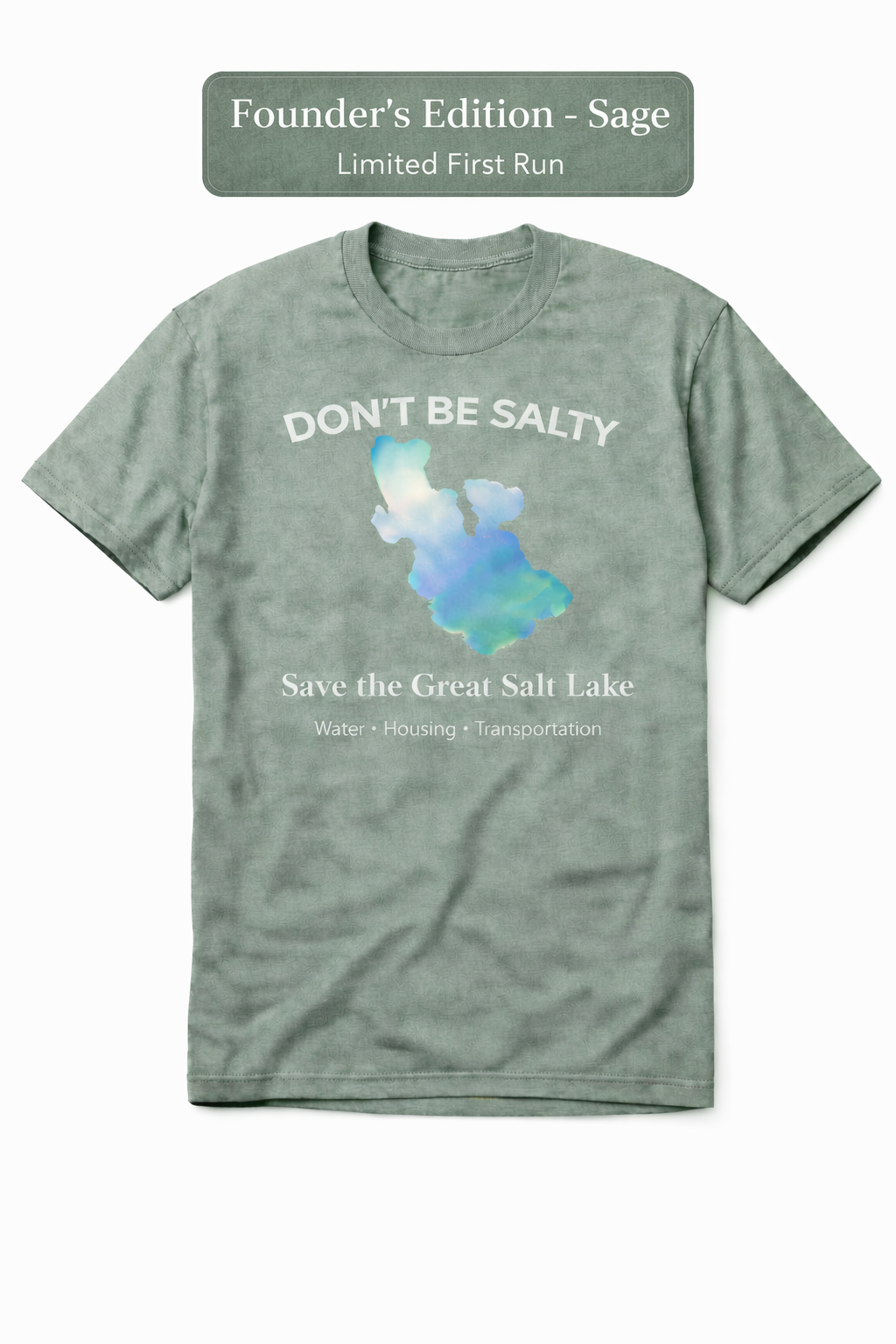
Don't Be Salty
Founder's Edition (Sage)
$35.00
The Sage Founder's Edition is part of our first campaign drop. Saving the Great Salt Lake is about responsible statewide water management, agricultural security, air quality, and long-term infrastructure stability. Sizes S through 4XL. Pre-order: shirts print once minimum threshold is met.
Paid for by Annette for Utah.
Order Now
January "Janus" Walker
United States Congress Candidate
The Great Salt Lake Act Sponsor
United States Congress Candidate
The Great Salt Lake Act Sponsor